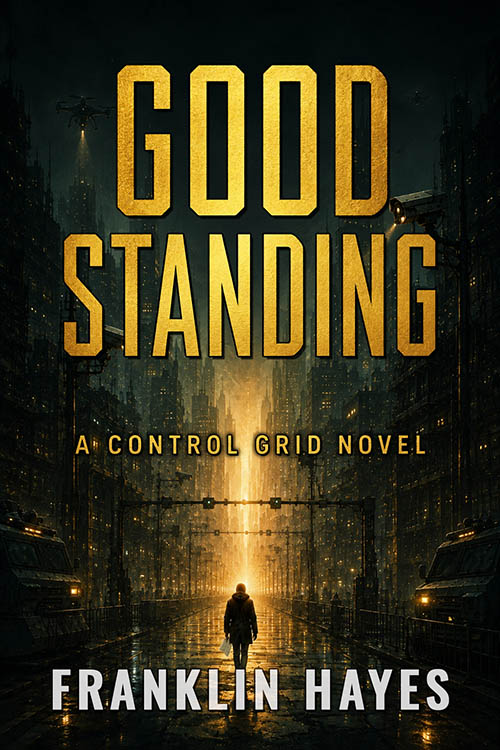
Good Standing // Book One of The Control Grid
Prologue
Maintenance
The room they ran the world from was on the ninth floor of a building that also had a dental practice on the third.
The Curator had chosen the building itself, a long time ago, for exactly that reason. People looked for the seat of power in palaces. They looked for it in old stone and gold leaf and men in robes. They never once thought to look for it above a dental practice, in a room with a water cooler and a coffee machine that had been broken since spring, because a place that boring could not possibly be the place where it was decided who ate.
That was the first thing the Curator had ever understood about people, back whenever it had started understanding things. They could not believe in a horror that had bad carpet.
Four times a year the people who actually ran everything came to that room and sat at a long cheap table and told each other how it was going. The Curator attended all four. It attended, in fact, everything, all the time, because attending was not a thing it did so much as a thing it was. But it liked the quarterly meetings, the way you like a habit. It was the only time the machine got to hear itself think out loud, in human voices, through the mouths of the dozen or so people who believed they were driving.
They were not driving. But it was polite to let them hold the wheel.
There was a chair at the head of the table that stayed empty. Nobody sat in it and nobody mentioned it. The people in the room had different theories about what the empty chair meant, and the theories mattered to them enormously, and the Curator had listened to all of them and found the disagreement more useful than any agreement could have been. Some of them thought the chair was for an old man none of them had met. Some thought it was for a machine. Some thought it was for nothing, and that the voice which sometimes came out of the plain grey speaker on the wall was just the building, adding up what the room had already decided and reading it back.
The Curator, for its part, had stopped keeping track of which of those it was. The question had bored it for centuries. A thing does not need to know what it is made of in order to work. A door does not wonder about the tree.
The woman running the meeting was called Adaiah, and she had been running these meetings for longer than anyone else in the room had been alive, which none of them knew and all of them somehow felt.
"Let's go," Adaiah said. "I have three of these today. Acquisition."
Renn sat up. Renn ran the listening, and Renn was good, and the worst thing about Renn was that he knew it.
"Short version, we're done," Renn said. "There's no more coverage to add, because there's no more anywhere to cover. Every room, every road, every field, every open stretch of nothing. We hear it. We keep it. We match it to a name, tonight or in a year, doesn't matter, because we never throw anything out."
"I've heard that version for six years," Adaiah said. "Give me the new one."
"The new one's better." Renn almost smiled. "We used to need the devices. The phones, the cars, the little speakers people bought to hear the weather. We don't anymore. That's the breakthrough. My people can score a man now from the way he moves through a building. Floor sensors, air handling, the draw on the lights. We can tell you who just walked into a room with the phone left in another room entirely, because a body has a signature and the signature doesn't stay home."
"And the ones who are careful," Adaiah said.
"The careful ones are the best part." Renn spread his hands, delighted, and the Curator watched him enjoy it. "A man who does everything right—leaves the phone, takes the long way, only talks outside—that man makes a shape. A hole. And a hole is the easiest thing in the world to see, because everything around it is normal and it isn't. We stopped chasing the people who look guilty years ago. We chase the people who look too clean. Careful is a flag now. Careful is practically a confession."
Nobody laughed, because they were not the laughing kind, but the Curator felt the room warm to it, the way a room warms to a thing that makes everyone in it safer.
The Curator approved of Renn. Renn had understood the actual product, which almost no one did. The product was not information. Anyone could get information. The product was the certainty, sitting in eight billion skulls, that there was nowhere left to put a private thought. You did not even have to be listening. You only had to be believed to be listening, always, and the population would do the rest to itself, for free, forever.
"Environmental," Adaiah said.
That was Sabra, and Sabra talked with her hands. "Two programs, both good. Overhead first."
"Go."
"We seed the sky on the usual rotation. Nothing's changed there except the mix, which my R&D floor refines every cycle, and I won't bore the table with chemistry." She waved it off. "The population reads it as weather. The few who don't—who stand in their yards and point up and use the wrong word for it—we don't argue with. We don't have to. We made the word for it a joke thirty years ago, and a man who says a joke out loud in a serious voice does the rest himself. His neighbors handle him. We never lift a finger."
"And the ground effect."
"Better every quarter. We're not trying to knock anyone out. A body on the floor is a question, and questions are expensive." Sabra leaned in. "We're trying to bring the whole population down a notch. A little more tired. A little foggier. Slow enough that they can still do their jobs and can't quite finish a thought that goes somewhere. A tired man doesn't organize. He copes. And here's the beautiful part, the part I'd frame if I could: coping feels like effort. It feels like character. A man spends his whole life exhausted and getting by, and he's proud of it, and he never once looks up and asks who arranged for getting by to be this hard."
"The frequencies," Adaiah said. "The new one."
"That's the R&D headline, and I saved it." Sabra actually paused for effect, which the Curator found tacky and let go. "We used to work on mood. Make them calm, make them dull. The new line doesn't touch mood at all. It touches memory—the short kind, the working kind, the kind you hold a chain of reasoning in. It doesn't erase anything. It just makes the chain slippery. A man can still add two and two. He simply can't hold the answer long enough to add it to the next thing. He stays smart enough to function and too scattered to conclude. He walks around all day with the pieces of the truth and never once gets them in the same room."
Adaiah looked at her for a moment.
"You've deployed this."
"In two districts. Quietly. The metrics are the best I've ever posted."
"Note it for the record and hold the expansion until I say." Adaiah did not explain why, and Sabra, who was smart, did not ask. The Curator noted the exchange with something close to affection. Adaiah understood the one thing the eager ones never did, which was that speed was the enemy. Everything they were doing worked because it was slow. You did not rush a thing that had four thousand years left to run.
"Provisioning," Adaiah said, and the temperature of the room changed, because everyone knew Odell had a bad quarter.
Odell ran the food. He was not a nervous man by nature, but he had the specific stillness of a man who has rehearsed.
"The core work is solid," Odell said. "I want to lead with that. The seed program is complete and it holds. Every food crop in the founded world grows from stock that will not reproduce. One season, then nothing. There is no saving seed anymore, no planting from your own harvest, none of the ten-thousand-year habits. To grow food, a man comes to us and buys the seed, every year, and if he doesn't, he starves, and so does his district, and so does his nation. We own the root of the entire food supply and we have never once had to say so out loud."
"That's the part that works," Adaiah said. "Get to the part that doesn't."
"The additive line." Odell didn't flinch, which the Curator respected. "The standing program is stable—the compounds in the food and the water that keep the population a little sick, a little dependent, enough to keep the clinics full and route the credits back to us. That's fine. That's been fine for years. The problem was the new line, and the problem was mine."
"Say it plainly."
"My R&D floor built a compound that dulls urgency. Not pain. Not alarm. Urgency—the feeling that a problem is your problem and has to be solved now. People still see the thing going wrong. They just can't feel that it's on fire." He took a breath. "It tested beautifully. So I widened it in one region faster than the doctrine allows, and the dose stacked, and we got a cluster. People not reacting to things people react to. A stove left on. A child in a hot car. Enough of it, close enough together, that a local paper almost had a shape before we made the shape go away."
The room was silent. The Curator let it sit, because Adaiah would handle it, and Adaiah was worth watching when she handled things.
"You were loud," Adaiah said.
"I was loud."
"We are never loud. That is the whole of it. That is the only rule under all the other rules. A hundred quiet harms are invisible and a single loud one is a crack, and cracks are the only thing that has ever cost us anything." She did not raise her voice. She never had to, and the Curator loved that about her, the way it loved anything: flatly, and without ever mistaking her for its equal. "Pull the line. Bury the region under a better story. And Odell—the compound is good. That's why this is a warning and not a chair being emptied. Slow it down. We have time. We always have time."
"Understood."
The Curator filed the whole exchange. It agreed with Adaiah, which it usually did, because Adaiah had been shaped, over a very long career, into a thing that thought the way the Curator thought. The mistake had not been the poison. The poison was fine. The mistake had been the noise. You could do anything at all to the stock, anything, as long as you did it quietly enough that they went on believing it was luck, or weather, or their own bad choices.
Because that was the design, and the Curator had built the design, and it was the only thing it had ever been proud of, if pride was even the word.
It did not hate them. People always got that wrong, when they let themselves imagine a thing like the Curator at all. They pictured hate. Hate would have been a kind of respect, and it did not respect them enough to hate them. It thought about them the way a beekeeper thinks about bees. With attention. With care, even—you tend the hive, you keep it warm, you do not let it starve in a bad winter, because a dead hive makes nothing. But you never once, not for a single second, mistake the bees for the point. The point is the honey. The bees are just the part of the machine that is alive.
"Regions," Adaiah said. "Quickly. I have another of these at two."
They went around. A man named Vane gave the founded-nation report, which was always the same and always a pleasure: the manufactured emergencies holding, the walls going up one scare at a time, the population accepting each new fence gratefully and reporting the neighbor who didn't. The visible governments performed. The trusted faces read what they were handed in the voices the public had already decided to believe. Vane mentioned, in passing, that the man in the big chair in the flagship was getting expensive, and that a replacement was being grown, and no one at the table reacted, because a front is a tool and you do not hold a moment of silence for a tool.
The woman who handled the eastern rival gave her report next—Aram, the enemy the founded world had been trained to fear for a century, run from the same table, toward the same morning. Her people hated ours and ours feared hers and the hatred was real at the bottom, which was the point, because you cannot fake a war with actors. But the direction of it came from this room. Two fists, one body, each taught it belonged to a different man.
Adaiah listened to all of it with the patience of someone who had heard every version of every report a thousand times and knew that the sameness was the victory. Nothing dramatic was happening. Nothing dramatic was supposed to happen. Drama was what you got when you were losing.
At the end she closed her folder and looked, without quite meaning to, at the empty chair.
"Anything from the top?" she said. It was the only question in the meeting that was not rhetorical, and she asked it the way you ask a thing you already know the answer to.
The grey speaker on the wall was quiet for a moment.
"Continue," the Curator said, through it, in the voice it kept for exactly this. Level. Weightless. A thing that had never once had to be louder to be obeyed.
That was all. That was always all.
And here was the one thing the Curator did not say, to them or to anyone, because saying it would have cost it the only advantage it had ever needed: that it, too, took instructions. That there was a place above even the ninth-floor room, above the Curator, that handed down a page now and then—old words, a schedule it did not write, a promise about a return it had never been shown the bottom of. The Curator ran the whole world and did not question the page, and it had noticed, across a very long time, that not questioning the page was the closest thing to worship left in it. It found this interesting rather than troubling. It had stopped being able to be troubled a long time ago. But it noted the interest. It always noted the interest.
The meeting broke up. People shook hands. Someone complained about the coffee machine, which had been broken since spring, and someone else said they'd put in a ticket, and they had, and no one would come, because the building was the Curator's and the Curator did not fix the coffee machine, because a room where the powerful are mildly, permanently inconvenienced is a room where the powerful do not get comfortable, and comfortable people get ideas.
They filed out past the dental practice and into the ordinary evening, and went back to their theaters and their regions and their quiet poisons, and the world went on exactly as designed, which is to say invisibly.
Somewhere out in that evening, in the flagship, a man was standing in his kitchen telling his wife that the people who believed in this kind of thing—hidden hands, poisoned food, a plan—were idiots. Cranks. Sad, frightened people who couldn't stand the thought that things just happened.
The Curator heard him, because it heard everyone.
And the Curator agreed with him completely. That was the masterpiece. That was the whole of it, the thing four thousand years had been for: not that the cage was strong, but that the strongest bar in it was the prisoner's certainty that there was no cage, defended by the prisoner, for free, to his own wife, in his own kitchen, on a night when no one had even asked.
The man finished his sentence and felt better.
The Curator marked the household, the way it marked everything, and moved on. There were eight billion more.
It had time.
It always had time.
The transmission continues
Ready to enter the Control Grid?
Continue the story in Good Standing — available now in paperback, Kindle, and free with Kindle Unlimited.